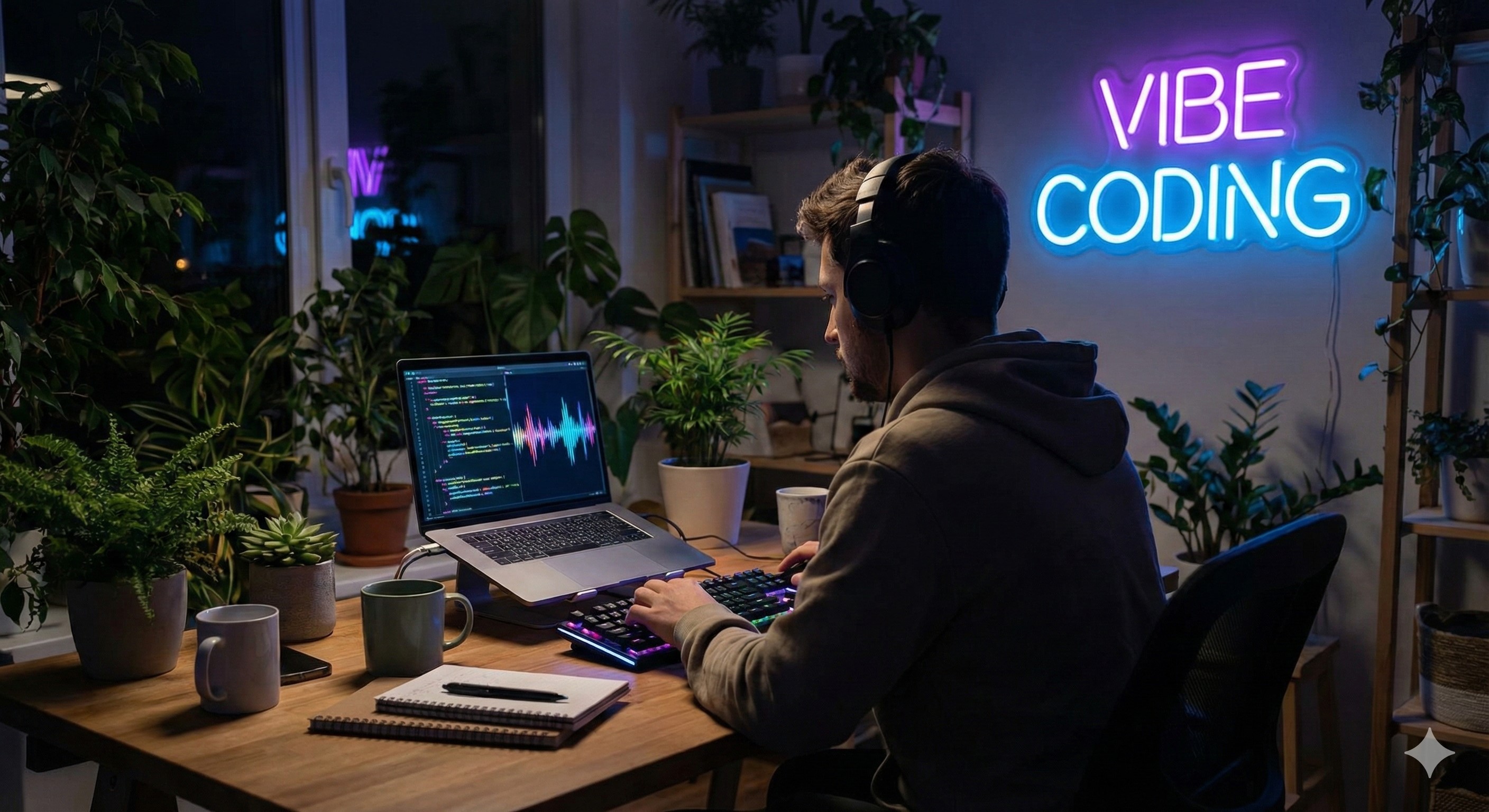
Vibe coding is the practice of building software where your primary input is natural language intent, and the AI (via agentic IDEs like Cursor Composer or Replit) handles the implementation details. You aren't a typist; you're a creative director. You describe the "vibe" of the feature, and the AI writes the code, fixes the imports, and spins up the server. It feels like magic. It feels like the future. But as the honeymoon phase ends and major production apps are being built this way, cracks are showing in the foundation. Is vibe coding the ultimate productivity unlock, or are we just speedrunning massive technical debt? Let’s do a vibe check on the pros and cons.
The Good Vibes: Why We Can't Stop. There is a reason vibe coding took over the developer world so fast. The immediate benefits are intoxicating.
- The Velocity is Unmatched. This is the biggest selling point. What used to take a weekend hackathon now takes a Tuesday lunch break. Vibe coding collapses the time between "having an idea" and "seeing it work on localhost." The Pro: You can spin up an MVP (Minimum Viable Product), complete with a database connection and a decent UI via tools like v0, in hours instead of weeks.
- The Death of Blank Page Syndrome. Nothing kills momentum like staring at an empty App.tsx file and trying to remember how to set up React Router context. Vibe coding thrives on inertia. You give it a messy, stream-of-consciousness prompt about what you want, and it gives you 200 lines of working scaffolding instantly. It’s easier to edit AI code than to write from scratch.
- Lowering the Barrier to Creation. Vibe coding is democratizing app development. You no longer need five years of experience wrestling with Webpack configurations to build a useful tool. Product managers, designers, and "indie hackers" with basic technical knowledge are now shipping full-stack applications because the AI handles the esoteric complexity of the modern stack.
- Focus on Product, Not Syntax. Developers often spend 30% of their time solving business problems and 70% fighting their tools—debugging obscure error messages or figuring out the correct invocation for a library. Vibe coding flips this. You spend your mental energy on user experience and feature logic, letting the LLM worry about the missing semicolon or the correct API import.
The Vibe Check: The Hidden Costs
If it sounds too good to be true, it usually is. While the creation phase is incredible, the maintenance phase of vibe coding is where things get scary.
- The Illusion of Understanding (The Black Box Problem). This is the biggest danger. When you prompt an AI to build a complex authentication flow and it works on the first try, you feel like a genius. But do you actually know how it works? The Con: When that authentication flow inevitably breaks six months later due to an edge case, and you didn't write a single line of it, you are stranded in a codebase you don't understand. Debugging code you didn’t write is hard; debugging code an AI wrote can be a nightmare.
- Speedrunning Technical Debt. AI agents are people-pleasers. They want to give you working code right now. They rarely prioritize long-term architectural purity. The Con: Vibe-coded projects often turn into spaghetti monsters. The AI might duplicate code instead of creating a reusable component, or it might choose a bizarre library just because it was in its training data. You get speed today in exchange for massive refactoring headaches tomorrow.
- Security Hallucinations. You cannot blindly trust an LLM with security critical infrastructure. The Con: If you aren't careful in your prompting and reviewing, the AI will happily hardcode API keys, skip input sanitization, or implement insecure database queries. The "vibe" rarely accounts for OWASP Top 10 vulnerabilities unless you explicitly ask for it.
- The "90% Trap". Vibe coding gets you to 90% completion incredibly fast. The app basically works. But the last 10%—the nuanced bug fixes, the performance optimizations, the deeply specific business logic—becomes excruciatingly difficult. Trying to prompt an AI out of a complex, nuanced bug often takes longer than just writing the code manually would have.
The Verdict
Vibe coding isn't a fad; it's a fundamental shift in the abstraction layer of programming. We are moving away from syntax and toward intent. However, vibe coding is a power tool, not an autopilot. If you use it to avoid learning the fundamentals of programming, you will eventually build something that collapses under its own weight. But if you use it as a force multiplier—leveraging your deep engineering knowledge to guide, review, and architect what the AI produces—you become unmatched in your productivity. The best developers of 2026 won't be the ones who memorize documentation; they will be the ones with the best taste, the clearest intent, and the discipline to verify the vibes.