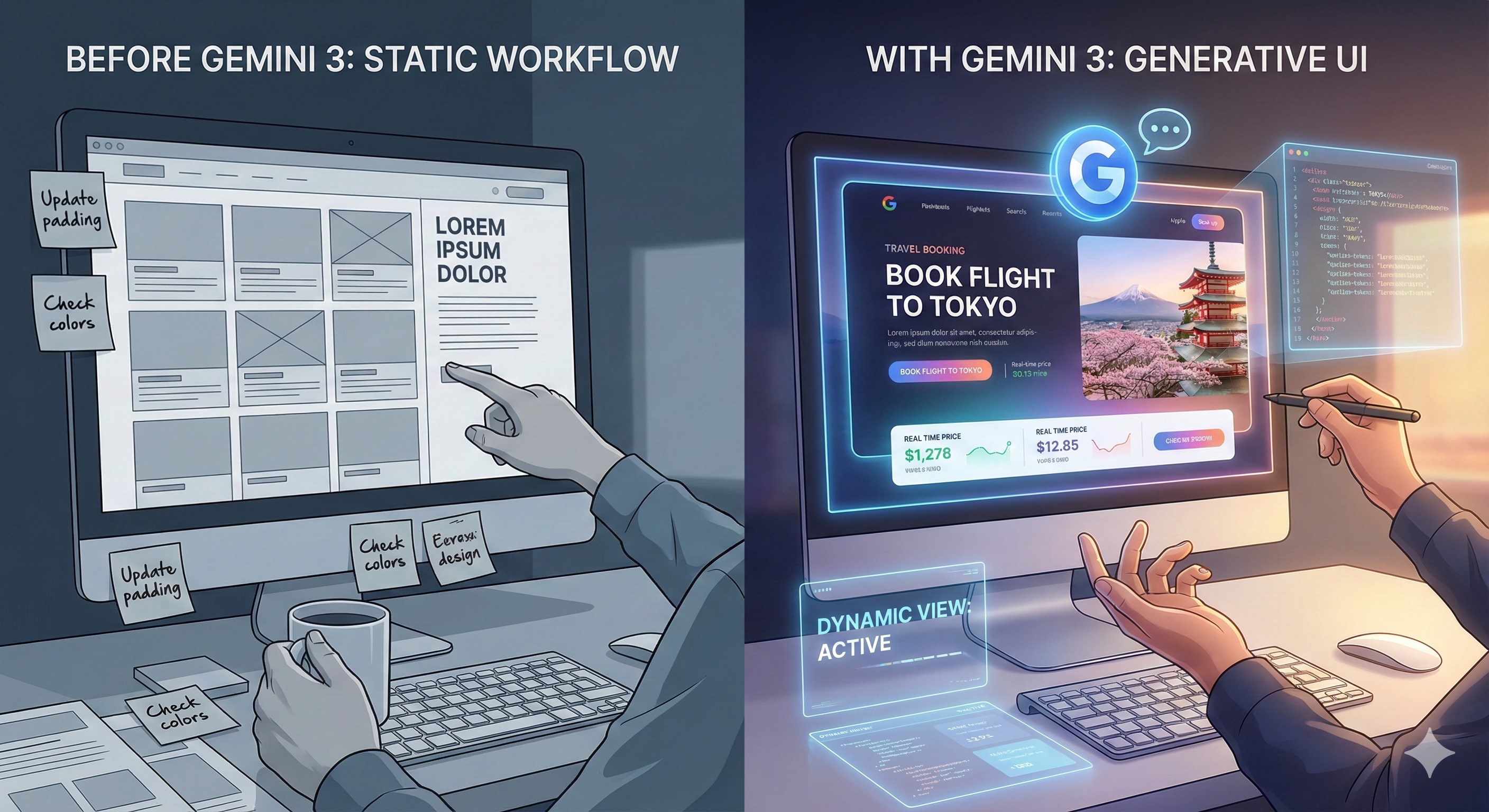
For years, we’ve designed representations of software. We draw rectangles in Figma, argue about auto-layout, and hand off redlines to developers. With Gemini 3, specifically the new Generative UI capabilities, we are no longer just designing the look of software. We are designing the logic of it, in real-time. Here is why Gemini 3 is a massive paradigm shift for our industry.
The marquee feature for us is Generative UI (launched with "Dynamic View" and "Visual Layout"). Previously, LLMs gave you text or code snippets. Gemini 3 generates fully functional, interactive UI components on the fly. What this means: You can prompt Gemini 3 to "Design a flight booking module for a minimalist travel app," and it doesn't just give you a PNG or HTML code. It renders a live, interactive widget that you can click, toggle, and test immediately. The Workflow Shift: Prototyping is no longer a separate phase. You can iterate on a "live" product instantly.
If you live in Figma, the update to the Figma Make plugin (powered by Gemini 3 Pro) is terrifyingly good. Deep Reasoning: It doesn't just "generate a dashboard." It understands context. If you have a design system loaded, it respects your tokens.
Vibe Coding: This is the new buzzword, but it’s real. You can upload a "vibe" (a mood board, a screenshot of a competitor, or a rough sketch), and Gemini 3 translates that aesthetic into your existing design system’s language.
Google’s new agentic platform, Antigravity, blurs the line between designer and frontend engineer. Agentic Prototyping: You can assign an agent to "build a settings page based on our current user profile schema." The agent writes the code, spins up the preview, and even runs basic accessibility tests. Asset Generation: With the new Nano Banana image model integrated, you aren't just getting placeholder gray boxes. You get context-aware imagery that fits your layout's palette and tone automatically.
This is my favorite part. Because Gemini 3 has state-of-the-art reasoning (scoring 90%+ on benchmarks), it understands content strategy. Contextual Data: Stop using "John Doe" and generic copy. Gemini 3 populates your UI with realistic, context-heavy data that actually breaks your layout—so you can fix it before production. It mimics real user behavior to show you edge cases you didn't think of.
Gemini 3 isn't replacing designers; it's promoting us. We are moving from "pixel pushers" to "experience architects." The grunt work of layout adjustment and data entry is gone. The real work—empathy, user flow, and solving complex problems—is all that’s left. Next Steps: If you haven't yet, go to Google AI Studio and try the "Dynamic View" mode. Paste in your toughest design brief and watch it build the solution in front of your eyes.